


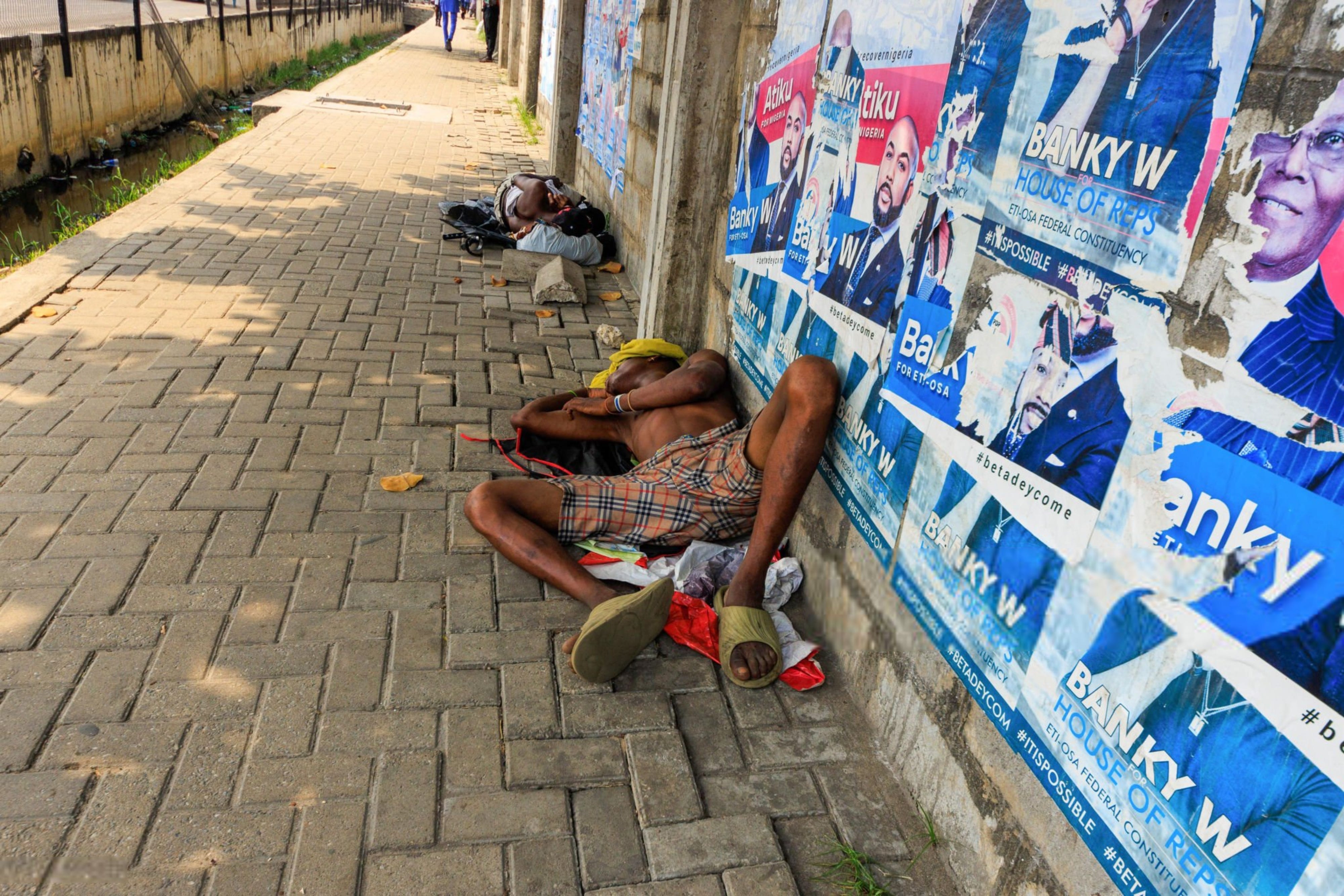
Philanthropy content creator Adeniran Bayo Israel, widely known as BayuzTV, posted a video that went viral immediately. Only days after he told the story of the latest beneficiary of a philanthropic act sponsored by a follower of his, he found the recipient of the act — a middle-aged mother and her two daughters who had set up home by the road — back on the streets of Lagos, begging, with her children in tow. Enraged, he did the unthinkable — alerted the police. The viral video of the woman locked in the backseat of a police car divided his fanbase into two factions: those who thought alerting law enforcement was too harsh and those who supported him vehemently.


The way I see it, there is barely any difference between the woman and the rather too aggressive young men who line up cars or harass every day Lagosians, demanding to be “shown love,” because they both operate from the same place.
Giving these people money when they ask, no matter how much they plead or how sorry we feel for them, does nothing to help. The only righteous reaction in this scenario is not to give them money, no matter how hard they beg. Because that is worse than bad philanthropy — it is evil.
If you look around you in Lagos, the evidence of this evil — the emboldenment of these good seekers who take it upon themselves to demand our good deeds as a form of involuntary tax — has not only furthered the pandemic but is making the city unsafe for everyone.
Philanthropy must be intentional — otherwise, it becomes poison to society. Philanthropic acts must not be shortsighted. People who engage in it, especially in a community like ours rife with scarcity, must see beyond the instant gratification of making someone feel good about an act we have done to or for them. It must take into consideration the long-term effect of said act on the community.
If, for instance, you are driving and young men run towards your car and demand money, and you give them, you create a system where you and other people have to give them all the time.
I have a rule about philanthropy. I only engage in it as extra payment for services or as a tip. I only tip when the person does what I consider a good job. After all, it is my money, so why shouldn’t good be the benchmark I set?



At a gadget store I frequently visit, I once encountered a new attendant. Many of the sales reps hired to work in the store are young people yet to attend university. So the store constantly changes staff as people leave to return to school. A flush of new talent had been hired at the store, and they didn’t know I was a regular. A sales rep attending to me could not have been more dismissive. I found her to be utterly condescending. But a different rep soon began attending to me. This one took her time to answer the questions I had about the product. So when I was leaving, I tipped her. The rude one immediately turned to me, wondering why I did not tip her, while also attaching herself to the one I did tip to claim the tip was a general gift for them both. I really could not be bothered about what happened to the tip. But I realised I didn’t need to say to anyone why I had not tipped the first rep. She knew her attitude towards me and other customers had been unnecessarily adversarial, so much so that she could not even muster the wherewithal to say a word to me.
This is what I would term good philanthropy simply because I gave to someone who was already diligent in their work to hopefully incentivise that attitude while also creating a cushion for them.
When we do philanthropic work, we incentivise that attitude of the receiver in the context in which the deed is done. In this sense, we should not just give for the gratification of alleviating someone’s burdens. Too many times, when people do philanthropic work, we do not think about the attitudes and the context in which we are giving — by so doing, we incentivise the wrong attitudes. What we have created by giving to people who see begging as an opportunity to earn a living is a society of young people addicted to begging and rejecting the workforce.
There is an even more sinister problem with bad philanthropy that turns around to affect those shortsighted enough to see it as good, including and especially those who claim it’s not a problem because they might be able to afford it for now. The overarching danger of bad philanthropy is that it incentivises apathy towards economic engagement.
Of what use is the economy to a group of young people who earn a living by begging from better-off peers?
This is always inadvertently a form of vote buying. Young people who do not depend on the strength of the economy or recognise how difficult it is to afford necessities on the current minimum wage or how many jobs one needs to do to make ends meet, see very little reason to embrace a politics based on long-term betterment of their lives.
In this context, almost anybody can win elections and be re-elected. Too many people become careless about the candidates vying for office — their arguments, their attitudes toward the public. Their focus instead turns to the candidates most likely to pay them for their votes. Even though they are aware that, in the long term, the candidate who pays them the most might not be good for the community, the candidate’s suitability for the job becomes unimportant because their means of survival is predicated on bad philanthropy.
