


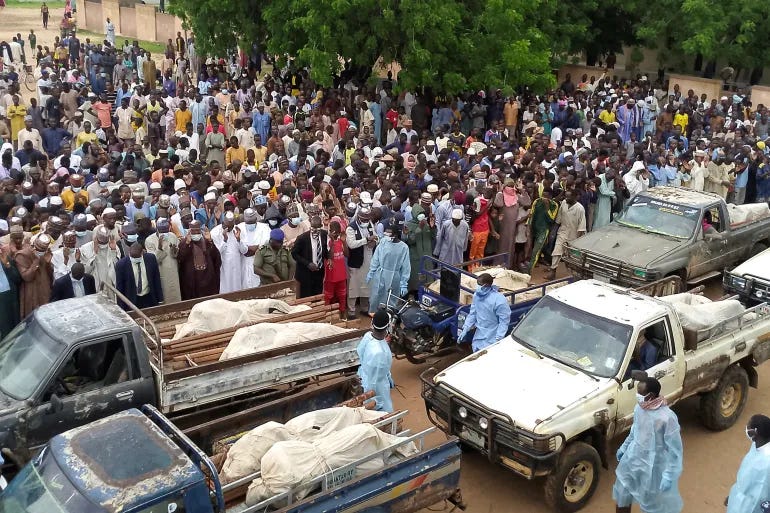
Debates around what constitutes genocide have very quickly become a hot-button topic. Many see value in claiming that there is no genocide, because in so many ways it furthers anti-Muslim rhetoric and decapitates any rebrand of a religion of peace. If we were to allow empathy to reign at this time, it seems to me that what is most important is justice for the families and comprehensive security plans and not the boundaries of genocide.
Are there extremist Islamists in the northern part of Nigeria? Yes. Are there other kinds of banditry groups that have risen in the wake of Boko Haram to terrorise northern villages and towns? Yes. Is it possible that these other banditry groups are also extremist Islamist? It is very possible. But to come to a clear-cut determination about whether or not they are means we would need to throw each and every one of them through an Islamist detector — or in front of a jury on jihad matters — who would then determine for us if they are extremist Islamist or not.
Ideally, the debate about whether they are extremist Islamists is not supposed to be important. In large part because it was extremist Islamists who gave rise to other forms of terrorism in the region. In that sense, they are responsible for all that has followed. But the debate is not really about whether they are extremists. This debate is not even about extremism. This debate is about all Muslims — and an opportunity that so far seems to have been rejected by the mainstream of the religion — to distance themselves from the extremist flank of Islam.
By demanding granular evidence that all banditry is not made up of Muslims as opposed to condemning all banditry — as they say, “not in the name of my God” — the Muslim mainstream instead is seeking commonalities, even worse, seeking to bring back into the ranks of the religion a group that should have been expelled long ago.
The only thing important, if we dare to show any empathy, against how one might be treated as a member of the religion, is to offer condolences and grieve with the family whose loved ones have been massacred. It is human beings that were killed, and what we should do is condemn these killings, distance ourselves from the perpetrators — not by both condemning and saying we don’t know for sure if they are Muslims, but acknowledging how deep extremism has found space in the religion — and then call it what it is, an extremist faction. And then offer a comprehensive security plan for the people of northern Nigeria.
In so many ways, positing that it has absolutely nothing to do with Islam as a religion is already dead. Just look around you. The world knows too well that Islamist terrorism is one of the many terrorism that exist today.
People have been killed. Some of them have been Christians. Some of them have been Muslim. These extremists have gone into churches and massacred parishioners. The contours of their campaign have been very clear. “We would hunt down people who do not believe in the same faith as we do, and we would force them to convert. We would kill them.” By its very nature, it is clear — this is jihad. Of what use is it to then, as a mainstream Muslim, to say it is not and then call those who say it is Islamophobic? How does this help end the terrorism wrought by extremist Islamist sects?
The claim that somehow, because other Muslims have been killed, therefore we cannot call it jihad or Islamist terrorism, never really had any skeleton to it. If at all, it confirms the argument I make here. That there are Muslims who are not Islamist, and they — only they — can play the next crucial role that the religion needs to be saved. That Muslims have been killed doesn’t equate to Islamists not doing the killing. It means the jihad is on the way, and Muslims who do not participate in jihad would be killed by its perpetrators.
One can only look at how mainstream dissidents of the religion are treated by members of the religion to see the root of the problem. Dissenting is rigorously discouraged, and so extremism becomes mainstream.
It is tough to distance oneself from one’s family of years. To look at one’s brothers and fathers in the face and denounce their fanaticism in meaningful ways — in tough ways. It is one thing to joke about a Pentecostal mother who prays too much about enemies being roasted. It is something else to look at one’s brother and say we should not kill the neighbours in the next village because of our differences in faith. Yet that is what we must do.
As far as we can remember, the north has been hostile to Christians, to every form of religiosity that doesn’t adhere strictly to an extreme fundamentalist form of Islam. People have been killed for so-called blasphemy. Sharia is a real-life constitution. Child marriage is at a high rate. Hiding women from society under the burqa is celebrated. Polygamy is endorsed. The community is policed by each other for deviants. Security is not guaranteed. It is Orwellian. All of these are only a few of the extremist Islamisms that are mainstream in the north. All Muslims have to condemn this because all of this is extremist Islam.
This is where real common-sense collective rejection of the terrorism in the north can start. By doing this, all Muslims expel the extreme flank from the ranks and begin to build a society worthy of the worship of God. We cannot achieve this by denying obvious edicts in the Quran and hadith as lies or misinterpreted passages from the holy books. But rather, face it head-on and say it was written centuries ago; you simply cannot expect us to practise this in 2025. This is a religion of peace.
You see, those who falsely claim that portions of the books have been misrepresented and invoke meanings from LaLa Land to fit into mainstream less controversial takes — for instance people who deny that no portion of the hadith claims jihadists who die in battle would get 72 virgins in heaven— create space for these portions to continue to be a potent tool for extremism and special-interest religious leaders. A better argument is — heaven is a religious place, and I am not sure sex is all we would have in heaven. There is so much sanctity there. This is something one of the prophets said, not the word of God.
Teachers interpreting religious teachings to suit their interests is not new. Paul in the Bible did it.
I don’t write this to be part of the dunking on Muslims. But rather as someone who has seen the kindness of Muslims and how the unwillingness of these kind Muslims to distance themselves from extremism has created a culture of collective guilt when it comes to Islamist terrorism. In so many ways, the reason why many Muslims see explaining how the banditry is not only being perpetuated by Muslims is important is in an attempt to ward off demands of collective guilt.
But by doing this, it also strengthens the argument of people who demand collective guilt for Islamist terrorism.
Not all Muslims are extremists. So many people know this. But so many would like Muslims to say this in clearer terms. These days, the debates about whether or not the killing in the north constitutes a genocide as a primary conversation have made it seem we are losing grip of that religion of peace.
It remains good Muslims of peace to redraw the boundaries of mainstream Islam.
But first, they have to consider the questions: Are you for the burqa or not? Do you condemn Sharia or not? Are you a jihadist?
FOOTNOTE: This essay is part of the Afro Adulting Productivity issue. Also read other essays from the issue below:


