
There has been a lot of noise on the internet from the Lagos Commissioner for Environment and Water Resources, Tokunbo Wahab, about being hard at work to fix the waste management crisis engulfing the city. But on the ground, as you might have seen in the past few days if you’ve stepped out of your home and encountered the heaps of waste across the state, or seen the many videos of them in your feed, it has been to no avail.
Two months ago, when I asked the manager of one of the Lagos Waste Management Authority’s (LAWMA) subcontractors why they had not come to clear out the trash after over three months, they told me they had been unable to dispose of the trash in the truck that they had collected for weeks and were facing a huge backlog. The manager added that the government had not intervened.
This was long before videos of trash littering and polluting our streets began to flood the feed. This was, of course, even before the floods heightened the effects of the derelict waste management system. About a week later, her team came and cleared my trash. They have not returned since then. In total, LAWMA has only cleared my trash twice this year. We are already halfway through the year.
I didn’t grow up in a city, or perhaps the part of it, that had any waste management authority. The Lagos I grew up in had dump sites or incinerators, open fields where people went and dropped their trash. Some of these sites, I later came to learn, were private properties that had been abandoned by their owners for too long. A hotel for the wealthy now sits on one of them.
Whenever we needed to clear out the trash, my parents paid Kole Kole—young men from the North who had come to Lagos seeking a better life—to pack the trash in their wheelbarrows. Many of them dumped it in those open fields. It sounds like a scene out of a Mira Nair film. But that was how the city worked just under two decades ago. We paid private companies to drain our wastewater when it was full. It worked for us because we could regulate it and keep our immediate environment clean.

LAWMA trucks started driving into our streets after Babatunde Fashola became governor. Even then, they were irregular, showing up once every month at most. At some point, we began to deal with subcontractors licensed by LAWMA directly. They were more regular, and we developed a personal relationship with them, paying them monthly upfront. We had their number and could call them if they had taken too long to come. Yet they could barely meet the demand, let alone clear the trash weekly. Kole Kole has since gone out of work. Now, as an adult, my neighbours have multiple waste drums, all almost always overfull.
The reason Lagos is dirty is obvious. Waste evacuation is not functioning as smoothly as it should. Yet the Commissioner has spent time posting videos of largely hard-working Nigerians—an elderly security guard at a school, a child dumping trash in the gutter—trying poorly to keep their immediate environment clean. He has said that “indiscriminate waste disposal is a violation of environmental laws” and told the public to “dispose of waste responsibly and use only approved waste management facilities.”
He also announced that John Ehidreme, a 56-year-old gateman at a school in the suburbs of Ikorodu, has been arrested after videos of him dumping refuse in a gutter just outside the school went viral. Were the owners of the school equally arrested? Did anyone bother to ask whether LAWMA came, but Ehidreme decided to hide the waste so he could dump it in the gutter? Has his family been informed of his whereabouts, given the history of the police? Did we ask the Commissioner what the “approved waste management facilities” could have been in this particular case, being a school?

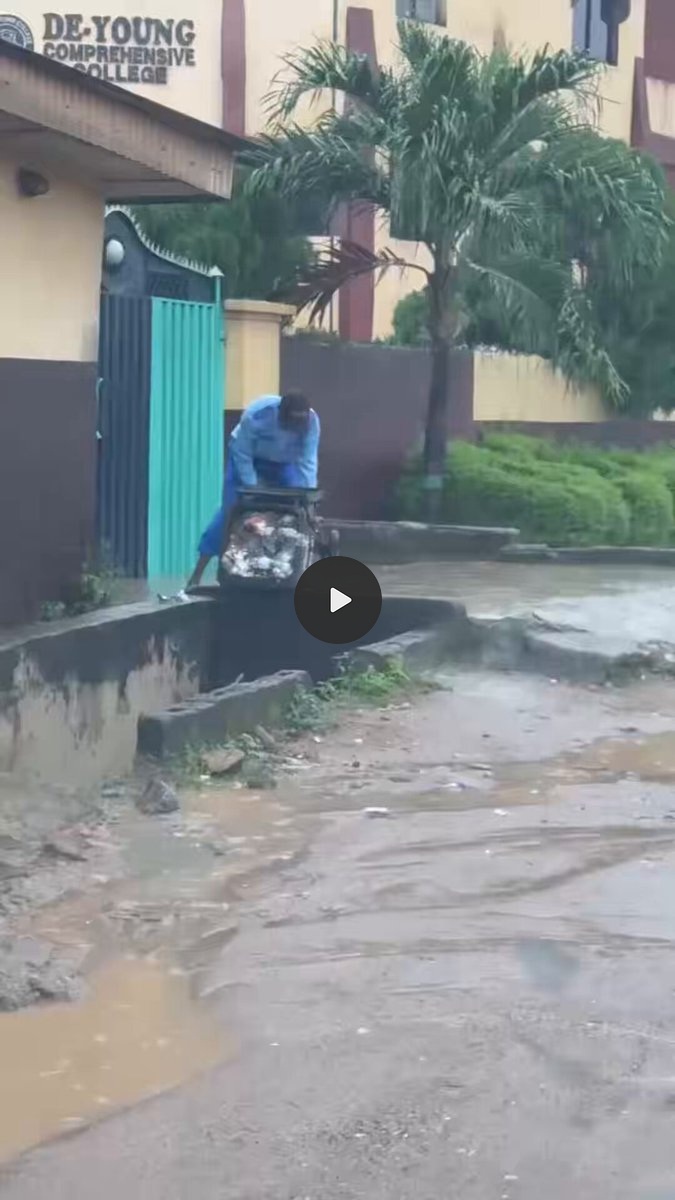
Yet the “1+1 = poor, uneducated Nigerian” wing of the city has jumped on the case, calling for severe punishment for Ehidreme. Even before he was arrested, they had demanded his head on a pike. The ineptitude of the government and civil service leaders, and the group that props them up, mostly equally rich people, will be the death of us as a country.
Funny, I saw someone who was at the wedding of a personal assistant to the Governor of Lagos just this past weekend blame “uneducated Nigerians” for this waste problem. I thought about taking a screenshot and naming him publicly, or perhaps asking him if he bothered raising it at the wedding, since he was in the presence of people who could fix the system. But calling out private citizens for problems wrought by the government is just as sacrilegious as the people who clamoured for Ehidreme’s arrest.
Classism has really done us a number, hasn’t it? But this event also underscores the dull approach to solving hard problems that we continue to take. In 2026, do we really imagine that society will work without incentives because everyone will wake up one day and just become angels? It is not just juvenile to be convinced this is the solution to Nigeria’s waste problems—that is, people leaving waste in their homes for months, waiting patiently for LAWMA to pick it up. Is this not also in tandem with the death of public discourse that this same class aggressively blamed the poor for weeks ago?
Do they really believe that, unlike them, poor, uneducated Nigerians are not victims of this government’s ineptitude?
To this crowd, the poor man is a waiting scapegoat for rich Nigerians to perform their moral high ground and show their care for their precious megacity.
In all of this, Muyiwa Gbadegesin, LAWMA’s Managing Director and Chief Executive Officer, whose LinkedIn proudly displays “Washington, District of Columbia, United States” as his location, has failed to roll out a comprehensive long-term solution. He first came into this role in 2019, with no prior experience in waste management. In fact, Gbadegesin has, since 2003, been either a paid consultant or full-time employee of the government, alternating between gigs with the Lagos and Oyo governments, per his LinkedIn. The commissioner, Wahab, came into his role with no verifiable experience working in water management and environmental development. He had been a lawyer for most of his life.
The problems of Lagos feel, at times, almost supernatural.