



Something as commonly spoken about as “helping” seems to be an easy task to carry out. Yet for many men, offering and receiving help is a technique we are not all equipped with.
When I first became a manager in media, I had a small team and we had a lot of work to do. Many of them were just in the early years of their careers. One had just returned from NYSC. Helping them succeed should have been as easy as holding coaching sessions with them, discussing blocks and working on ways to overcome them, sharing relevant materials, and providing them with honest feedback.
Eventually, I found a rhythm that worked, but for the most part, even though I did the logical things, I didn’t offer effective help to them. In fact, I came off as a condescending manager who was too focused on the work.
This happens quite often in formal and informal settings. A father ordering his son to get on a bicycle and push the pedal to get it moving might work for one child. But another might need a bit more time. They might need their father to hold the wheel a bit longer and push them on the bicycle before they get the hang of it.
Offering help is less about the actions and more about the results. It has to be effective and focused on meeting the needs of the receiver; otherwise, it hasn’t been productive.
In his 2009 book Helping: How to Offer, Give, and Receive Help, the American writer Edgar H. Schein charted a path forward for us to offer help in effective and productive ways. When he was alive, Schein was a professor at MIT Sloan School of Management. In his private life, he consulted for some of the most ambitious Fortune 500 companies.
What makes Helping continue to be an excellent resource for many leaders struggling with providing assistance is that it focuses on the effectiveness of the act. Good help is useful and productive.
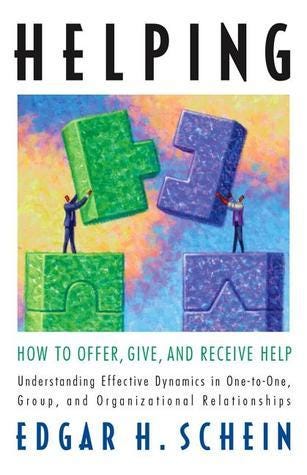
Here are 9 quotes by Schein from Helping and how they can help you navigate a helping situation.
“Help in the broadest sense is, in fact, one of the most important currencies that flow between members of society because help is one of the main ways of expressing love and other caring emotions that humans express.”
Seeing someone struggling and deciding to devote your time to getting them out of their situation is what helping should look like. It is also one of the ethos of Afro Adulting. For me, it was the suicide and loneliness rates that brought me here.
Many times, we are unbothered about the people around us who desperately need our help, but do not see it or refuse to seek it. But that is not a reason for us not to offer it. If at all, as members of a society, if we want our society to thrive, removing these blocks and helping where we can is the way we should go. It is one of the most potent ways of building a society where empathy is at the centre of its engineering.
“Check out your own emotions and intentions before offering, giving, or receiving help.”
The crypto bros—and most recently gym bros—who have presented themselves as guides for young men have looked at how society currently functions and concluded that their tips are the best way for young men to navigate the world.
But this often leaves the young men who take their advice lonely and undesirable to honest women looking for nourishing relationships with healthy partners. In large part, these solutions are less about solving the loneliness and addiction that young men suffer, and more about getting even with women. The intention of the help is corrupt, and so it is not effective.
The intention has to focus on solving the problems that young men are facing. If a man has been battling loneliness, helping him will focus on the realities of finding a mate—by making himself more desirable and better at seeking women also looking for healthy partners. It means, for instance, he has to be kinder to the women he likes, not meaner.
“Remember that the person requesting your help may feel uncomfortable, so make sure to ask what the client really wants and how you can best help.”
I recently started consulting for media companies. It was a new gig that more or less fell on my lap. The editor of one of the companies asked me how much I charged per hour. In Nigeria, we rarely charge per hour, so I spoke to a friend who I knew had done consulting work. I gave him very minimal information because I didn’t want to overwhelm him with my problem.
He could have just given me his rate card and left me on my merry way. But that would not have been effective for the problem I had come to him for. Instead, he told me how much he charged but also added that it would depend on the kind of company and the amount of work they wanted me to do. I left the conversation with more questions about my engagement with that company. When the second client came along, I knew exactly what to do.
“The point is that no matter what you do or don’t do, you are sending signals; you are intervening in the situation and therefore need to be mindful of that reality. Unless you are invisible, you cannot help but communicate, so your choice of communication should be based on what kind of intervention you intend.”
When I worked at the media company I mentioned earlier, I was offering help, but I wasn’t intervening intentionally, so it was unproductive. When I moved on to another company and a new team, I learned that I didn’t need to be forceful when it was an honest mistake—because the chances of it reading less as drawing my team’s attention to the error and more like condescension were high.
“Everything you say or do is an intervention that determines the future of the relationship.”
When I was leaving that company I referenced in the intro, my relationship with the team had been so battered, I didn’t even want to see them. When offering help, almost everything that needs to be said can be said, depending on the context and what the relationship allows.
It’s why we are comfortable telling close friends and family members we hate their work when we do. The relationship allows for that. And this is underpinned by trust—they trust that we want the best for them and are only offering our honest opinion. We have to get them to trust your help.
“When you are giving feedback, try to be descriptive and minimise judgment.”
I like working with a manager who has a clear direction and shares that direction with me. Then I know what the goals are and can work toward achieving them. Once, I had a manager who didn’t see value in that but rather played dull mind games, coaxing you to guess what he was thinking. When you got it wrong, he wrote on the document that your solution was off—but he never said why it was.
It was not useful to me, and I learned nothing working with him. A better approach for me is to clearly state what the goals are, and if someone strays away, remind them of the goals. If we want the theme of the story we are working on to be about making money, I clearly state it. In this way, there would be no need for judgment because if money is not emphasised, we would just rework it to emphasise it.

“In building the helping relationship, encouragement—via positive reinforcement—certainly seems appropriate. But if it is not sensitively handled, such encouragement can quickly become patronising and insulting.”
This is a trap that many fall into, especially when trust is lacking in the relationship between the helper and the receiver. When I worked with the mind-games manager, I concluded that he was unserious and would offer him multiple options until we found what he wanted. Even then, he still accused me of being condescending, even though I didn’t voice any pushback.
Being able to forcefully disagree and explain to a receiver of your help that they are getting it wrong is vital—not just for the goal but for the relationship.
“Share your helping problem. More often than I care to admit, I have found that when I was supposed to be helping someone, I suddenly did not know what to do next. When this happens, the best thing to do is to say to the client, ‘At this point I am stuck—I don’t know what to do next to be helpful.’”
I was once working on a story with an intern, and she was stuck on a paragraph. I wasn’t sure what happened. As I asked her more questions, I realised that the problem ran deeper than the paragraph and would come back to us.
I wasn’t sure how to help her because I had already shared resources with her on the subject and also read it with her. We had only just finished discussing it. So I asked her how she would like me to help her navigate the situation in a way that would give her the result she needed.
She didn’t have the answer, but that moment helped strengthen our trust in each other and made it easier for me to offer help to her in the future.
“Though helping is a common social process, it is not the only social process. Our relationships with others have many other functions. In order to offer, give, and receive help effectively, we also need the ability to shift from whatever else we were doing and adopt a readiness to help or be helped.”
Ultimately, offering effective help—or receiving it—is about our willingness to achieve the goals we set for ourselves. If my plan is to help a friend with gambling get on track, starting out by judging his life choices would likely be a failing strategy because it fails to consider that gambling is an addiction—and addiction is a sickness.
This essay is part of the Afro Adulting #OfferingHelp issue. Also read other essays from the issue below:
What comes to mind when you think of “Nigerian men?”

I remember when in primary five we had the debate, “Men are better than Women.” This was a real academic debate that we had to contribute to. When the guy who was the lead debater on the men’s side said, “Women could become architects, but I have never seen a woman roofing a building,” all the boys leapt to their feet in cheers. It was my teacher who had told him that line.
Thank you for sharing.