


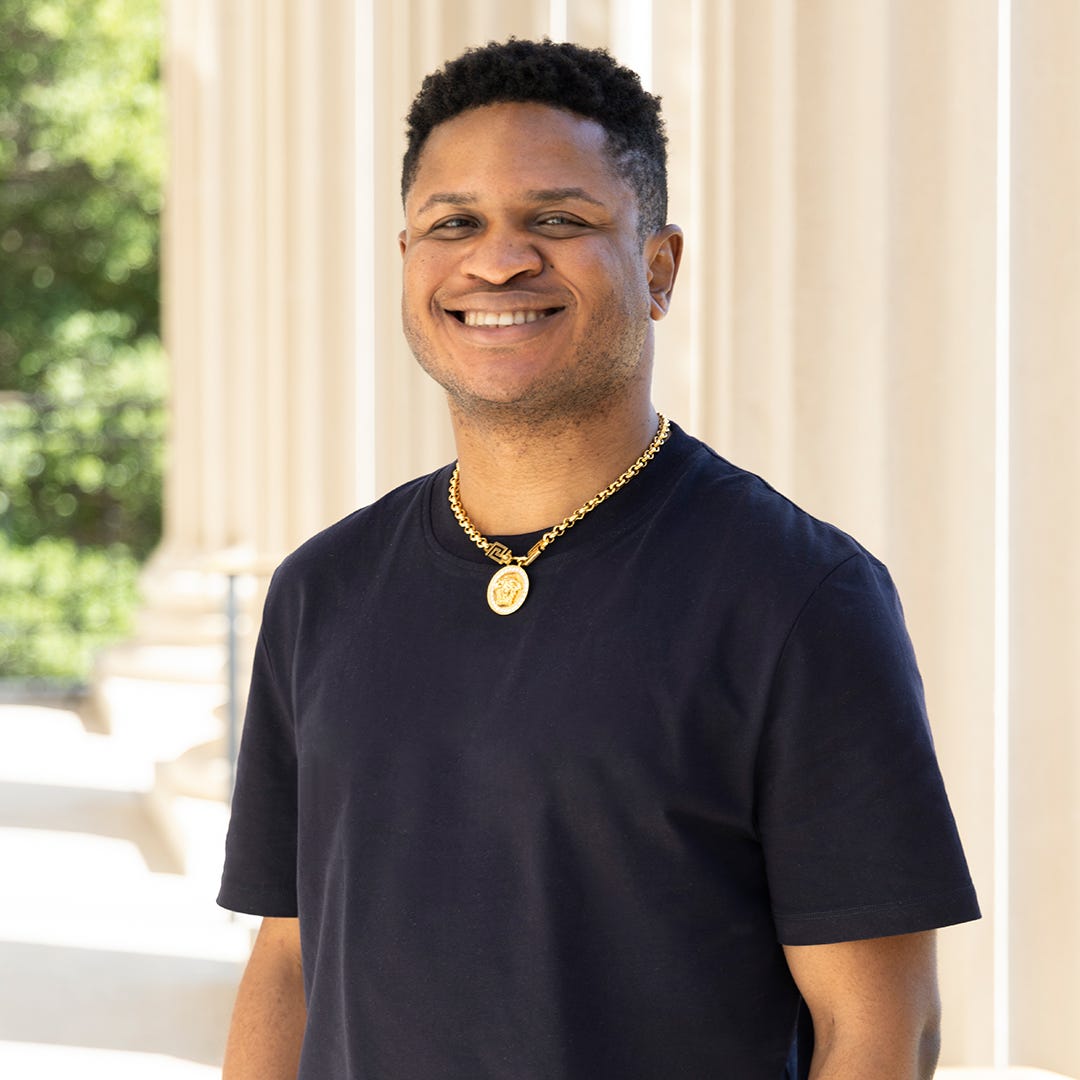
I can mostly tell when any piece of writing was written by or in part with the help of AI, which is why I wondered why, according to reports, some 14 publishers were locked in a bidding war for Jerry Falade’s debut crime novel, Call Me, I’ll Hide the Body, which his agent, Sandy Hodgman now says she can’t substantiate that AI was not used in producing the manuscript.
“Jerry Falade produced an incredible manuscript that dazzled us and the top publishing professionals around the world. Unfortunately, we are no longer able to authenticate how the manuscript fully evolved from origin to completion,” Hodgman said in an email to international publishers obtained by The Guardian.
“During the submission process we vetted the manuscript with Jerry for AI and felt trusting in his reassurance that it was written without utilising AI as a resource in the writing or editorial process. We can no longer substantiate that, and we are withdrawing the book.”
Minotaur, a subsidiary of Macmillan US, won the rights to the book in a deal that multiple reports say was worth at least $2 million. The manuscript was also allegedly being shopped to Hollywood executives for a screen adaptation. The deal has now been cancelled.
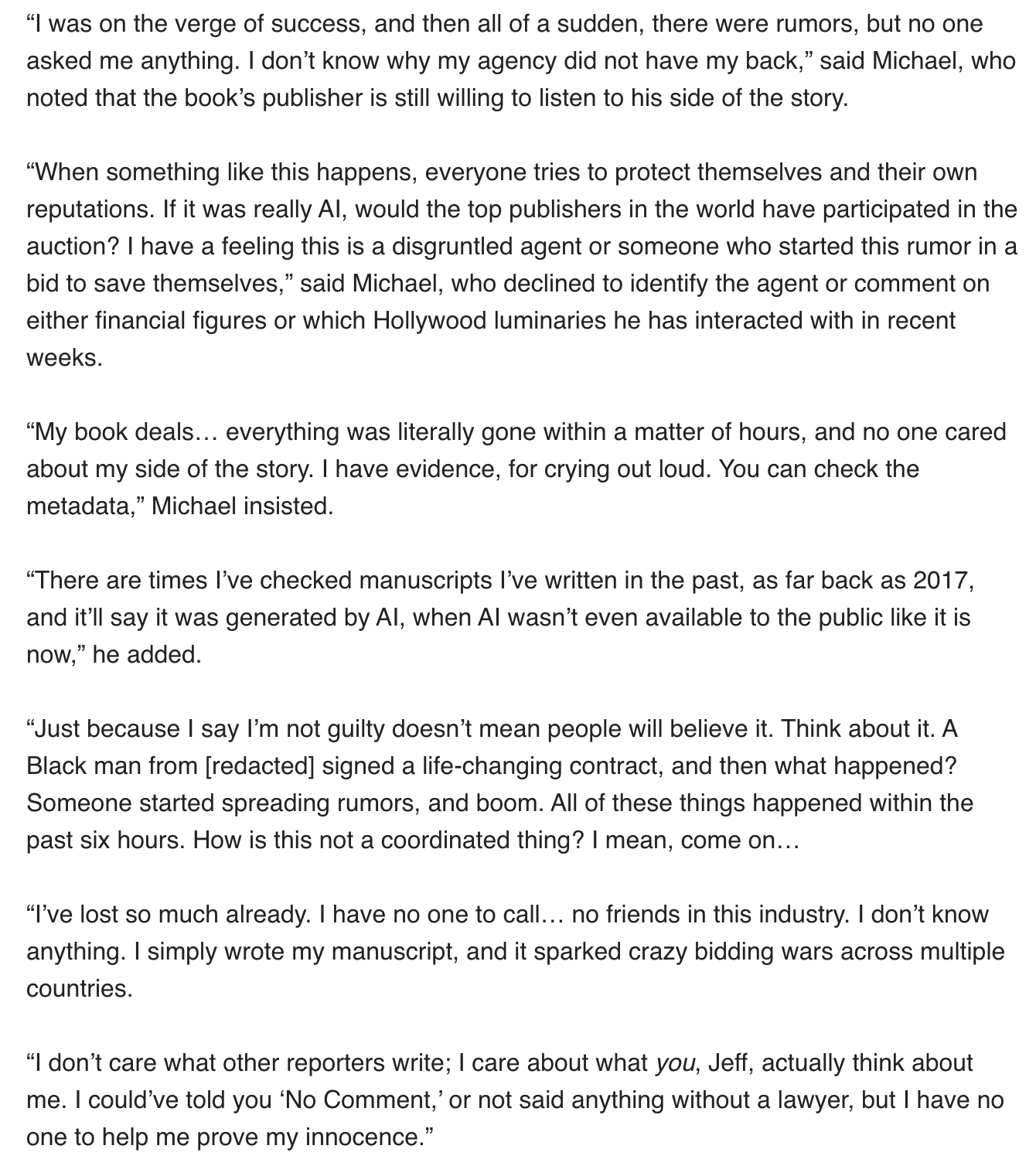
Falade has denied the allegations, implying they might be racially motivated. “Three Black authors received major publishing deals this year, and all three later had deals cancelled or disrupted following suspicions about AI. There seems to be a troubling assumption that when a Black writer produces work that attracts significant attention, the work could not possibly be their own. Meanwhile, there are popular white writers who have publicly mentioned using AI for their writing processes, and they’re still doing fine.”
In an earlier conversation with entertainment journalist Jeff Sneider, Falade said he had “evidence” to prove he is innocent.

This comes after Jamir Nazir (The Serpent in the Grove), Mia Ballard (Shy Girl), and HM Wolfe (Daggermouth), all writers of colour, were accused of using AI. They have all mostly denied the allegations. Ballard said it could be an editor she hired who used AI. Nazir said he writes with an AI voice assistant because of his health.
Steven Rosenbaum, the author of The Future of Truth: How AI Reshapes Reality, ironically a book about AI, and Matthew Goodwin (Suicide of a Nation: Immigration, Islam, Identity), both white men, have also faced accusations of using AI to produce their work.
Not too long ago, I had a conversation with a writer trying to get a job at a magazine I used to work at. They had not heard back from the company, and they wanted to know why. So I asked them if they used AI in their application. They didn’t answer the question. Instead, they asked how anyone would know for sure if someone used AI. I told them they didn’t need to know for sure. They are not looking for proof; they just need to suspect. They said it meant the hiring team used AI as well. And then I asked them why they wanted to be a writer. Their response was, in the future we will look at this moment with embarrassment because every piece of writing will be done by AI.
As the AI kerfuffle has increased, I have found myself returning to a much bigger question I used to ask early on in my career as an editor: why do people who could not even stand the thought of reading, let alone writing, want to be working writers? Now more than ever, I find that question to be relevant. The tech industry has openly touted wanting people to use AI. Vibe coders, on average, earn more than most writers. There are writers whose book deals are as low as $20,000, while a tech worker could earn $10,000 per month as a base salary. To me, it seems smarter if one must use AI to opt for vibe coding instead.
Writing with AI is not a problem in and of itself. It’s the lying that the writing was done by a human that makes the author a fraud.
On this app, someone once accused me of using AI to write. I didn’t feel offended by the suggestion. I found it strangely amusing. My response to him was simple: “if e easy, you sef, run am.” What my response loosely translates to is that if it was that easy, then he should give it a try.
I can’t say that with the AI detection tool, Pangram, and the hawkish approach to fishing out authors who use AI to write their work, I don’t have concerns. Like with many things, I worry about the slippery slope in front of us. Pangram, which now has a partnership with Substack, is not a system I can trust to be accurate. In fact, the only work I use the Pangram feature on Substack for is mine. However, that does not mean we should not talk about authors that we suspect might have used AI in their work.
I find when people are accused of using AI, it boils down to proof and whose burden it is to provide it. But I think we might be missing the point of this moment and the opportunity it might present for the literary industry to reset. There is too much slop being pushed at readers, and this slop has been around long before AI began to disrupt our lives.
I read not to detect whether a work is written by AI. I read to be delighted, to quench my curiosity. No piece of text excites me as much as a well-made argument in the written form. The sentences that make up these arguments feel like a sweet song in my mind. Like the Stone-singers in The Lord of the Rings, my mind answers their calls. When AI is used to write them, the song is hard to follow.
I suspect the reason we continue to return to this ditch is that people, even those who claim to read books and buy them, are no longer listening for the songs in the sentences. I once listened to a book review podcast where an editor said they read Hanya Yanagihara’s A Little Life in one evening. It felt like such a shame that person thought that was how to savour an almost 900-page book.
The publishing world has been so commercialised to its detriment, a lot of people have forgotten that sentences are supposed to sing. Some never learned how to listen for its songs. Many don’t even know they do.
We can never know for sure if Falade used AI to write the book. But at least we should have been able to tell what kind of song the sentences sang. There is no burden of proof to be determined here. There is bad writing and good writing—the tasteful and the tasteless. Sometimes we pay a premium for tasteless things, and if that is the case with Falade’s $2 million debut, I am not worried.
Here is how I think this moment will play out. People who can still hear the song will continue to come to the written form for the reason they always have, looking for sentences that will excite them. Others will be forever shut out, never understanding what the rage about human-written work is really about.

If you care to check out my substack, I think I did a fairly good job of establishing that he’s the real deal.