


I have written in a previous edition of this newsletter about my interaction with a writer who told me I would look back at this moment in history and feel utter shame for ever arguing against “writers” using AI to write. Months ago, when that writer said this to me, I thought it was a one-off. But a recent viral post on Threads reveals just how widespread this sentiment has become in some corners among people who would like to call themselves “writers.”
Chet Morjaria, who describes himself as an “Award-Winning Author” with “15+ yrs mentoring coaches,” posted on Threads a few days ago: “A writer saying ‘I’ll never use AI’ in 2026 will soon sound as ridiculous as a writer saying ‘I’ll never use the internet’ in 1996.”
His post is, of course, comparing two very different scenarios. One is a writer’s refusal to be on the internet, which will not impact the conclusions that they might come to in an essay if they carry out their research in an analogue library. The other is calling for the writing to be completely outsourced, while aggressively seeking to also be called the author. It’s like the passenger claiming to have driven the car because they gave the driver directions.
Morjara doubled down in a later post, saying that, ‘If you’re a writer proudly announcing you’ll never use AI, I don’t think you’re protecting the future of writing. I think you might be protecting an outdated definition of what a writer is.” It’s ridiculous on its surface.
I do not propose a total rejection of AI, especially for experienced writers. AI has proven capable of speeding up research and can function as a virtual assistant, helping with note-taking, quotes, etc. But the argument that writing should be outsourced to AI underscores an aversion to the form by those who argue in favour of this position.
Writing is not just the stringing of words together. Writing is the sacred way we make sense of the world. Writing is how we preserve humanity. When we write, we do more than bring sentences together. It is supposed to be and feel like a journey, imbuing our minds with more agility. At the end of the writing journey, we are supposed to have come to a conclusion about what it was we sought to make sense of.
Years before he released De revolutionibus orbium coelestium (On the Revolutions of the Heavenly Spheres), Nicolaus Copernicus knew that the Earth orbited the Sun, but he sat on the information, ruminating about it. It was only after he published the book in 1543 that his discovery provoked the scientific revolution. Such is the power of the written word. His discovery became a moral good only after he put it into writing, synthesising for the public what he had discovered.
If you read and write, you will already know how writing helps synthesise our thinking and ultimately the conclusions we reach on a subject, but that it has to be said to people who desperately want to identify as writers reveals just how bad our aversion to thinking has become.
The conclusions of well-argued essays are very important. They can start a war and end a war. It is essential that we do not outsource this to AI. The stock in trade of a writer is intellectuality, his ability to help the public engage with the issues shaping our lives.
This is why I have embraced Pangram, and I think writers should. This is not an attempt to create a new lords-and-ladies hierarchy in the writing world. Rather, what is before us is a moral duty to preserve our ability to think for ourselves. People who choose to use AI to write already do so and should be allowed to continue, but only in an ethical way that allows the members of the public uninterested in slop to opt out.

It is hard to find a tutorial on how to make an ice cream on YouTube without being overwhelmed with AI videos that don’t even show the ice cream maker. The sense-making institution must not devolve into AI slop.
The past few weeks have revealed just how much work is needed to pick up the pieces of what is left of the legacy sense-making institutions, from newspapers to book publishers. There is a dearth of taste that has led to a dearth of competence and stagnation, if not regression, in many societies. The 100% AI scores that Pangram has provided about everything from award-winning short stories to opinion pieces in the Financial Times did not reveal anything new. Writers have for years been sounding the alarm about a bias in the industry that was silencing thinking that deviated from the status quo. What Pangram is doing is providing proof of this.
This is also why AI has become very attractive to this crowd. AI is only as good as what it is given. An industry drunk on cognitive bias, not open enquiry, will see writers who are good at toeing the line soar. A match made in slop hell.
Pangram is not perfect. It is the way of new technology to continue adapting to the needs of its users. Embracing Pangram and other AI detection tools is going to help us label AI-written work more accurately because greater use will make the tech better. It will also compel those who choose to write with AI to pursue it ethically by explaining how AI was used in the writing process.
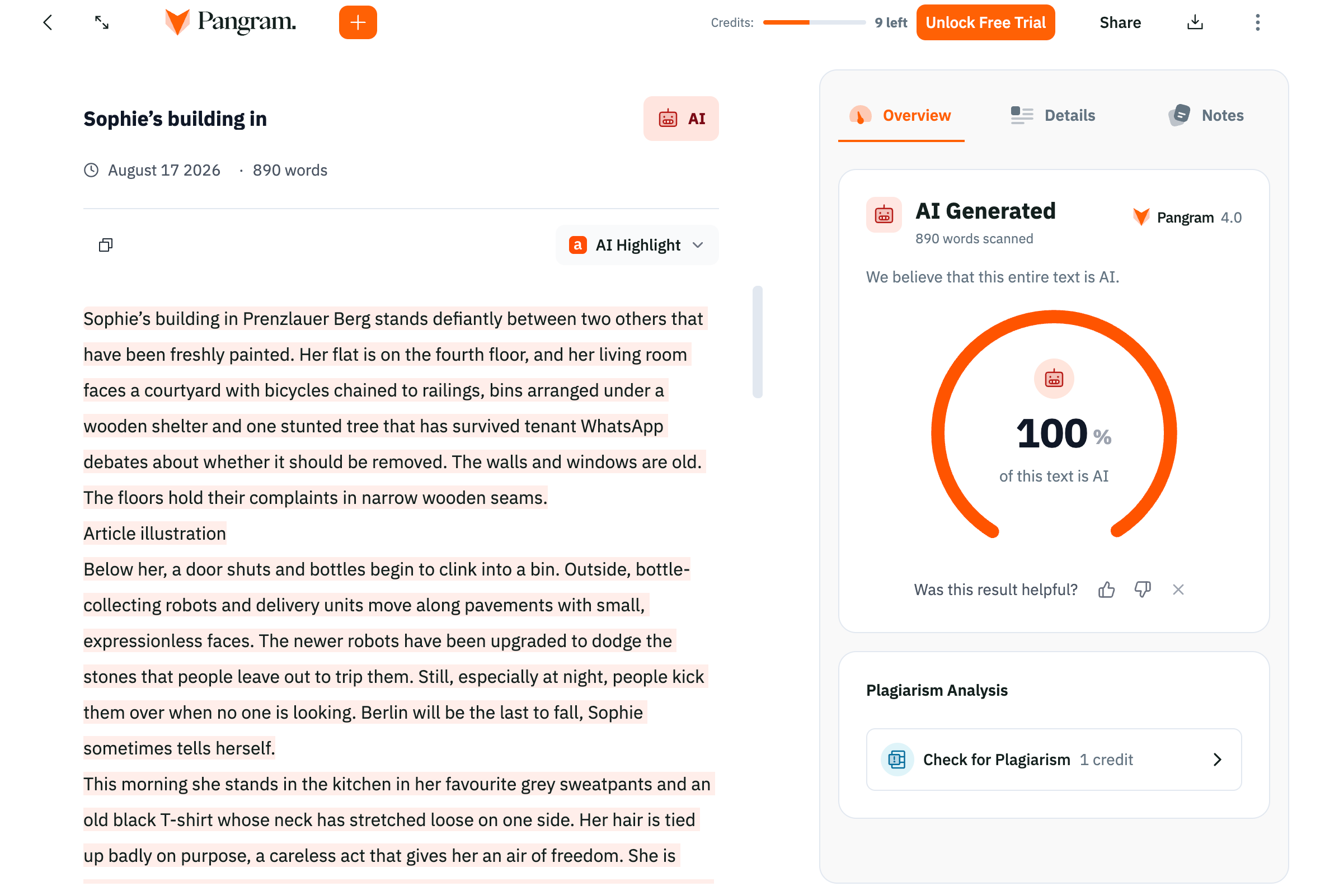
The arrival of Pangram in particular sent shockwaves around the writing world, with many writers decrying its use. The Nigerian author Elnathan John was a staunch critic of Pangram as an AI detection tool, blocking users on X, including myself, who were critical of the judges of the Commonwealth Short Story Prize this year after some winning works showed evidence of AI assistance. Pangram scored at least one of those works as 100% AI. An 800-word portion of a new short story by John, published in the Nigerian magazine The Republic, scored 100% AI on Pangram. This story is published at a time when readers are pulling away from literature and the industry is largely suffering from it. With many writers out of jobs, we should not be publishing AI slop and then turn around and wonder why the public is refusing to pay for it.
Embracing Pangram is one way we weather this and take back our industry. There are many ways to contribute to a conversation without being a working writer. If writing is not something that you can do, for the sake of humanity, I beg you, please stop overcrowding the feed with slop.
