


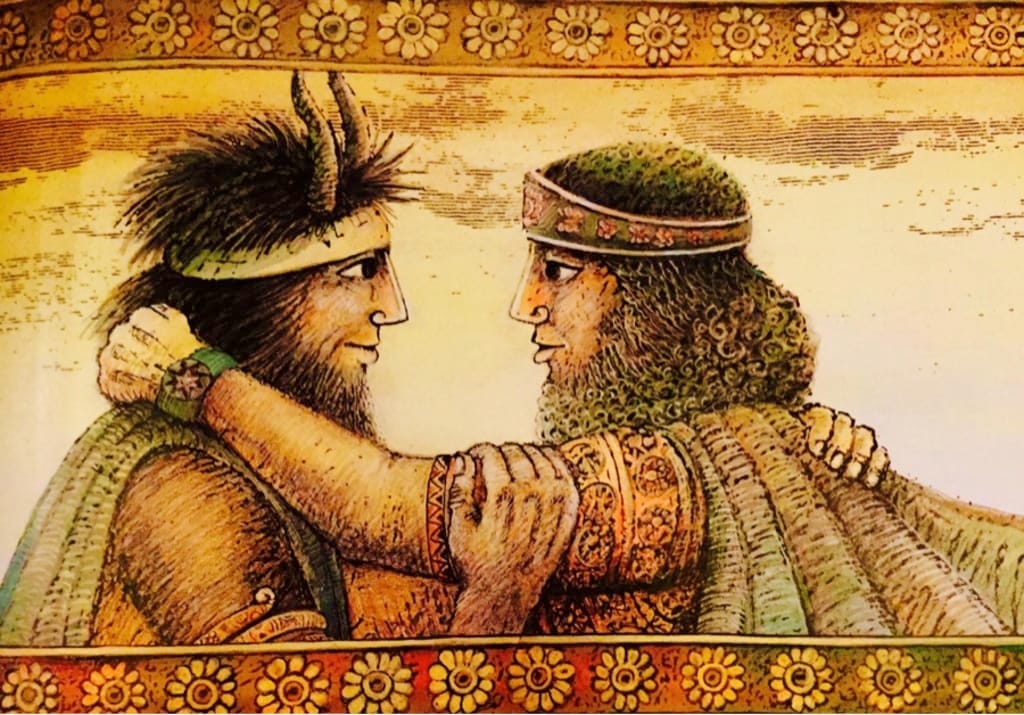
The oldest known written poem begins with a story about male rivalry. Years after men had only just come down from the mountains and taken shelter, building homes, Uruk emerged as a dazzling city that represented everything we could only dream of. Built around 3000 BCE, its remains can still be found in remote regions of modern-day Iraq.
In the poem The Epic of Gilgamesh, Gilgamesh was the tyrant ruler of Uruk. A demi-god. Towering above all the men in the city in height and charisma, he was wealthy and strikingly good-looking. He didn’t need to announce that he was better than the other men of Uruk; gigantic statues of himself he commissioned dotted the city, hidden behind high walls.

Until Enkidu, a wild man from the forest, with no titles and no wealth, challenged him to a duel. After days of fighting, the epic goes that each man eventually surrendered, and they became friends. Gilgamesh invited Enkidu into his home and his life, shared his riches with him, shared stories with him. The story is told that the friendship leads Enkidu to his death with Gilgamesh by his side. But I want to focus on the dynamics between the two men and how, years later in the 21st century, men still seek these kinds of relationships.
If you’ve ever been on the receiving end of the Enkidus of this world, or perhaps the people that invented him, you already have an inclination of what I am talking about. Strange men that show up in your life, seeking, at times impatiently, familiarity, and immediately turning on you for delaying to respond to their request, ultimately getting aggressive, demanding a fight. The fight is the ultimate ritual of humiliation, the only judgment for a reluctant Gilgamesh.
There is a type of man that the Enkidus seek out: the towering figures on the scene. In which case, it is nothing that you might have done or said that draws their ire. So battered, most men will create space for them and, just like Gilgamesh, invite them to break bread with him. But in the event that these men deny them said entry, the threat of violence ensues.
Nowhere is this rejection more documented in modern media than with the men who embody the spirit of Gilgamesh on Big Brother Naija. From Teddy A to Sheggz to Kola, men who stand out from whatever it might be — a sense of charisma, fashion, or even perceived wealth — but reject being part of the pack, a leader of the pack, even, or a consistent contributor to the pack, are often attacked by the other men of the pack. Accusations of condescension, arrogance, wickedness, demeaning posturing, or even gender sellout are cast on them.
It is a tough spot to be in as a man receiving the onslaught of these attacks from the Enkidus. The Enkidus themselves, so blinded by the ways of their fathers, fail to conceive that the Gilgamesh might not just be interested in this friendship.

The contract for those who see Enkidu as a forefather, or for those who simply believe and practise this form of bro code, is that men like this must stand at the centre of the circle or be humiliated publicly. They must offer themselves as alphas of the pack, otherwise instability in the male structure ensues.
When the most charismatic, strongest member in a baboon troop refuses dominance, the troop begins to face an existential crisis. A new alpha, less charismatic but more passionate as it were, might arise. Even if the abdicator remains in his place, not rocking the boat, the air of sacrilege remains. It is taboo. Early observers of baboon hierarchies documented the tension that historically ensues when status within the troop becomes unclear. Rivalries intensify, alliances fracture, and younger males begin testing one another. Everything goes awry, and the troop eventually disintegrates, forming smaller troops in new territories.
Among men, we begin to itch for the fight because fighting is how Gilgamesh and Enkidu settled their score. While the men of Big Brother might struggle to vocalise what scores the housemates that loathe them so have come to settle, or even why they are insistent on fucking them up seemingly out of the blue, deep down they know what it really is about, and they know what they are doing. Sometimes these abdicators are not saying an outright no to being an alpha. Sometimes they’re saying no to the specific pack. But the punishment for men like them that abdicate is supposed to be humiliation, and so the verdict continues. They are supposed to be brought into the open for rejection, as Enkidu intended to do with Gilgamesh.
The modern-day Gilgamesh, who rejects the alpha title, is often alone, with one or two other men that he confides in. The aggressive taunting that the sons of Enkidu wield in the lead-up to the final shaming ritual is less about anything that Kola or Teddy A or Sheggz have said or done. In fact, those men were mostly minding their business, trying to win the show. The taunting is an attack on the charisma, to root out the veneer of prowess.
I once knew a Gilgamesh. He appeared to be the wealthiest among the group. He wore the trendiest designs in the best quality and constantly displayed rare things and told rare stories. Unlike the men who rejected this role and shut their doors to the crowd, he shared everything he had with the crowd. He was beloved at the gate. All the boys looked forward to hanging out with him. Sometimes I wonder what his life would have been like if he had raised his walls like Gilgamesh, displayed the spoils of his wealth, and shared it with no one. Would he still have been popular?
I like to believe that the people who told the story of Gilgamesh and Enkidu were warning all alpha males of the future, who many may turn to for leadership; the only way to survive this is to embrace it. Do this, and they will gladly go to war and die for you.
