



There has never been any doubt in my mind that a pile-on on a marginalised group will find refuge in another oppressed group looking for release from their own unending, spiralling oppression. But growing up, the idea that slavery, colonisation, and racism in general were to be condemned, never rationalised, on the continent of Africa was unshakable.
That idea is now collapsing.
A new wave of ultra-right conspiracy theories has somehow muscled its way onto the continent to demand perhaps the most insidious form of obeisance from Africans. It camouflages itself as part of a campaign for common sense. But its tenets are anything but common sense, and its goal is to outsource Africans for the dehumanisation of Africans.
I will provide two examples of this and why the Africans who argue in favour of these ideas are well aware of their racist themes, but are choosing to do so regardless. They do this because camaraderie in punching down on Africans is the utmost libidinal desire for this group of deplorables.
One of their talking points is that white people ended slavery.
Slavery has been in human history for years. Even at its peak, when it was the economic backbone of many ancient economies, it was grossly unpopular, especially of course among the people who lived their lives on their knees in chains as slaves. At the tail end of the 19th century, it was abolished in America, one of its last strongholds, where many slaves were Africans stolen from their continent.

But leading up to that, there had been multiple uprisings among the slaves, as far back as the 17th century, more than 100 years prior. One such protest, now known as the Haitian Revolution, lasted from 1791 to 1804 and led to the Republic of Haiti, the first Black republic and first nation created through a successful slave revolt. Multiple similar campaigns took place at the time, including the Berbice Slave Rebellion (1763) in Guyana, the Fedon’s Rebellion (1795–1796) in Grenada, the Bussa’s Rebellion (1816) in Barbados, the Curaçao Slave Revolt (1795).
In the United States, slave abolitionists were also keeping the campaign going by rescuing slaves from plantations. Harriet Tubman, a Black woman herself who escaped slavery, became the paramount figure of the abolitionist movement.
The point of the argument – white people ended slavery – is not really to seek evidence of the contributions of Africans and other marginalised groups in the abolitionist movement. The point of the argument is to dehumanise and infantilise people of African descent. The argument here is that Africans and people of African descent should be eternally grateful and not act too entitled to ideas like basic human dignity because, after all, if it were not for white people who fought and died to end slavery, while your ancestors were happy to be slaves, you might still be on the plantation.
The argument here is to say Africans don’t deserve basic human rights. The argument here is to say that the verdict about whether these people should ascend any ladder or not is very much open. The argument here is to say the slaves were happy being slaves, they were productive and didn’t care about mundane things like washing machines and maternal mortality.
It is why the latest of this campaign has settled on Lupita Nyong’o, who plays Helen of Troy in the latest adaptation of Homer’s The Odyssey by Christopher Nolan. This is the second example.
In the past few weeks, a picture of the Kenyan Hollywood actress Lupita Nyong’o from the film 12 Years a Slave, in which she played the slave Patsey and won the Academy Award for Best Supporting Actress, has been reposted by this group. The picture has been edited, putting Nyong’o in a white Hellenistic dress alongside actresses from previous adaptations who are white, wearing the same dress but from movies where they play Helen of Troy.
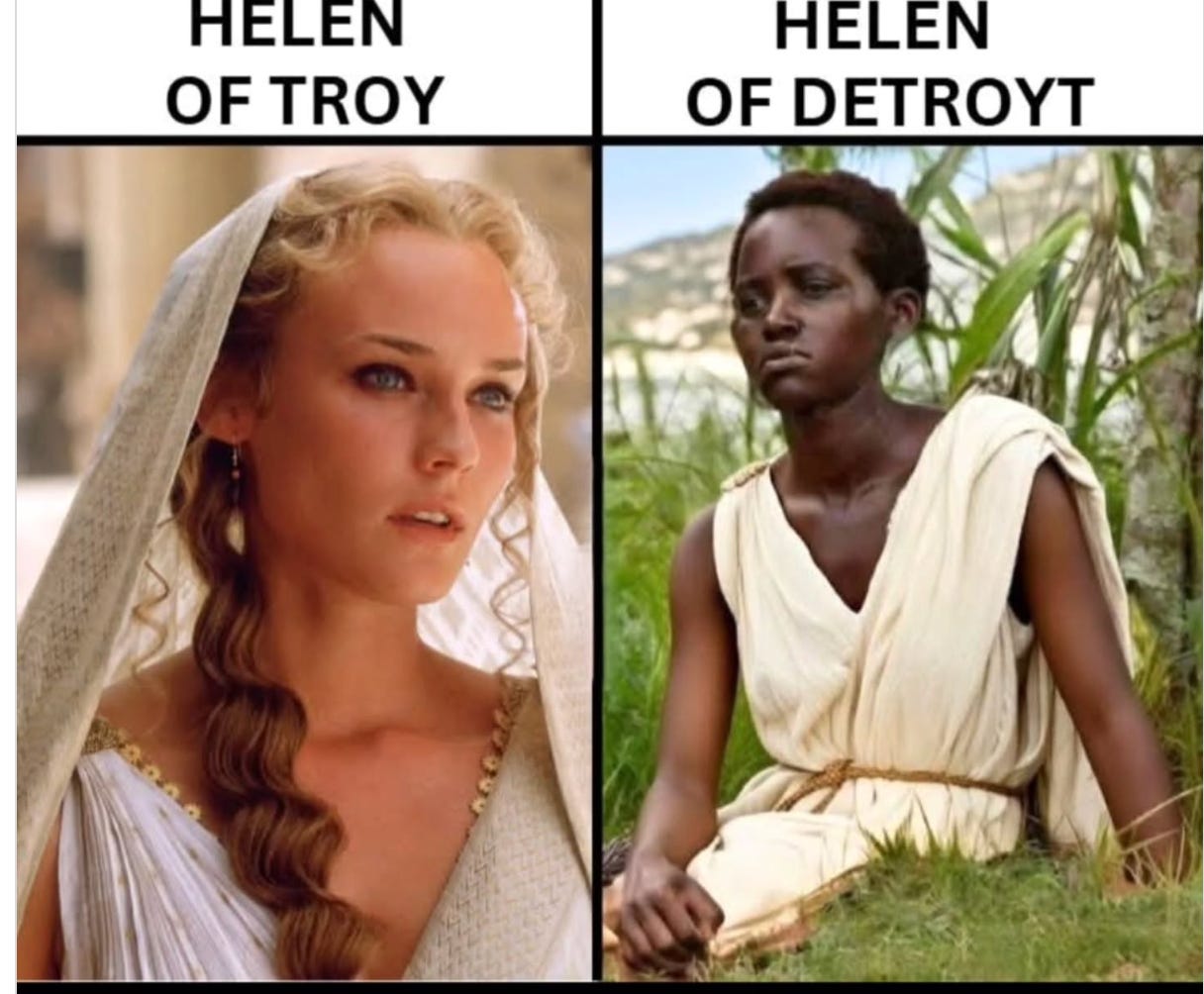
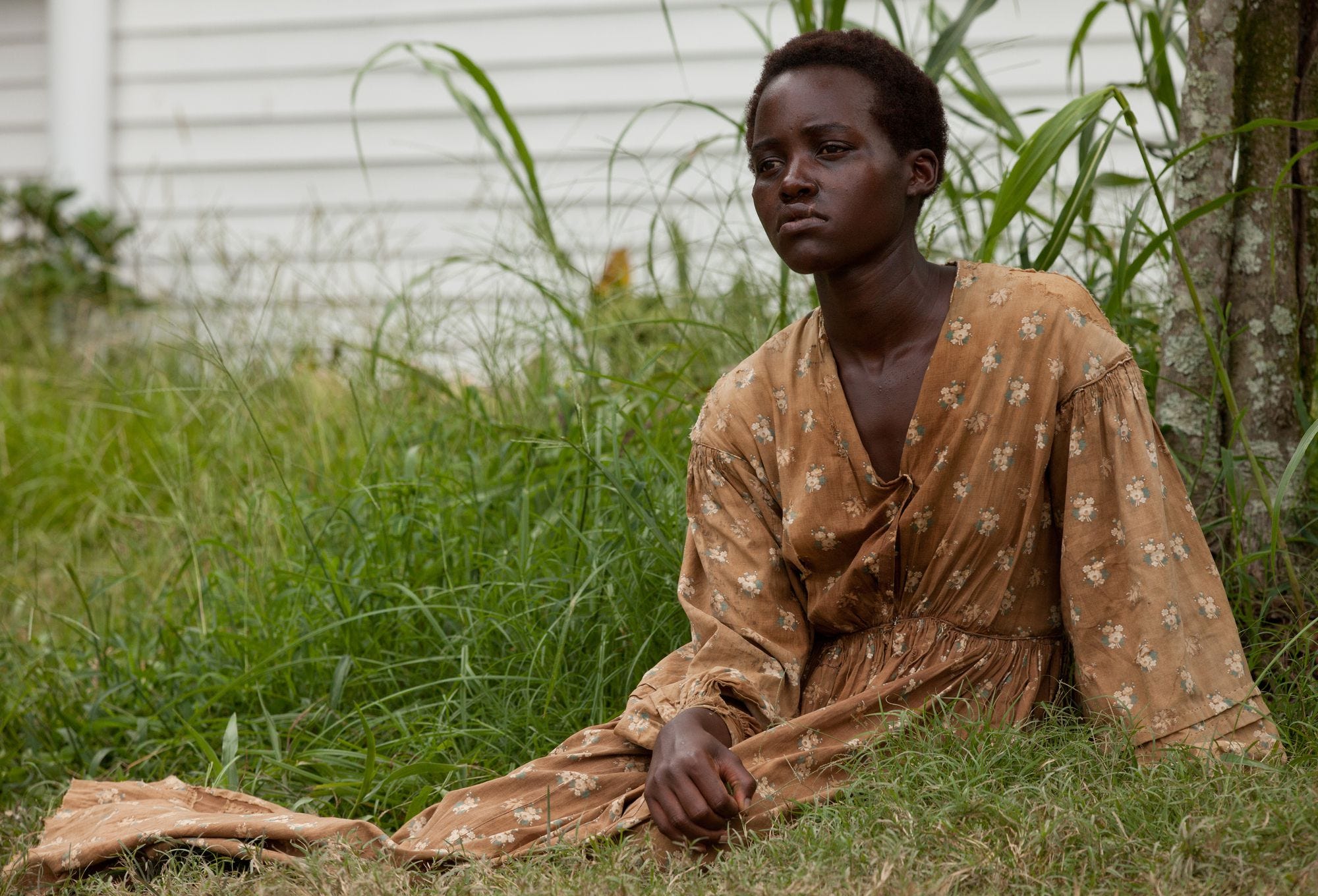
It suffices to say the picture of Nyong’o does not portray the actress in her best light. In them, she is Patsey, and Patsey was a slave. Using that picture to make the argument is the first instance where the racist undertone of the argument shows its hand: “Helen of Troy should not be played by this person who looks like a slave.”
But what they have said, even as they make the insidious comparison of Nyong’o’s physical appearance as a slave in the film, the picture is from, is that Nyong’o should not be Helen because she is African and not linked to ancient Greece, the setting of the film. But this leads us to even more rejection of common sense for racism.
In Nolan’s film, Odysseus, the king of Ithaca, is played by Matt Damon, an American actor of Scottish descent. Eurylochus, Odysseus’ brother-in-law, is played by Himesh Patel, a British actor of Indian Gujarati descent. Zendaya, a mixed-race American actress, plays Athena, the Greek goddess of wisdom, warfare, and handicraft. Benny Safdie, an American actor of Syrian Jewish descent, plays Agamemnon, the brutal king of Mycenae.
Yet Lupita Nyong’o is the one singled out for her ancestry and that awful picture.
Some have made the claim that this portrayal is tantamount to whitewashing history. Except that The Odyssey is not based on history. It is fiction based on characters from Greek mythology, where gods rape women and live on Olympus, a shiny mountain towering over the skyline. Do the Africans who are peddling this argument realise that to call this “whitewashing of history” is to claim that Olympus is a real place?
This is why there is no excuse that Africans who further these right-wing racist arguments are not doing this from a place of ignorance about what is fact and fiction. It takes guts for anyone to claim Greek mythology is a historical fact. But when the work of marginalising Africans is at hand, even common sense must be suspended in its furtherance.
The goal here is to normalise racism and reinvigorate old Western myths about what a Black person can and cannot do or be. The point here is to stunt Nyong’o’s ascent in mainstream Hollywood, send a message to other Africans and recruit Africans to do this work. It is why these Africans are up in arms, taking up these fights even as we have real fights in front of us that are more pressing than whether or not an African actress can play Helen of Troy.
These racist arguments are gradually finding acceptance on the continent and spreading. They offer no common sense. Their goal is to dehumanise us. We will do well to be wary of them.
