


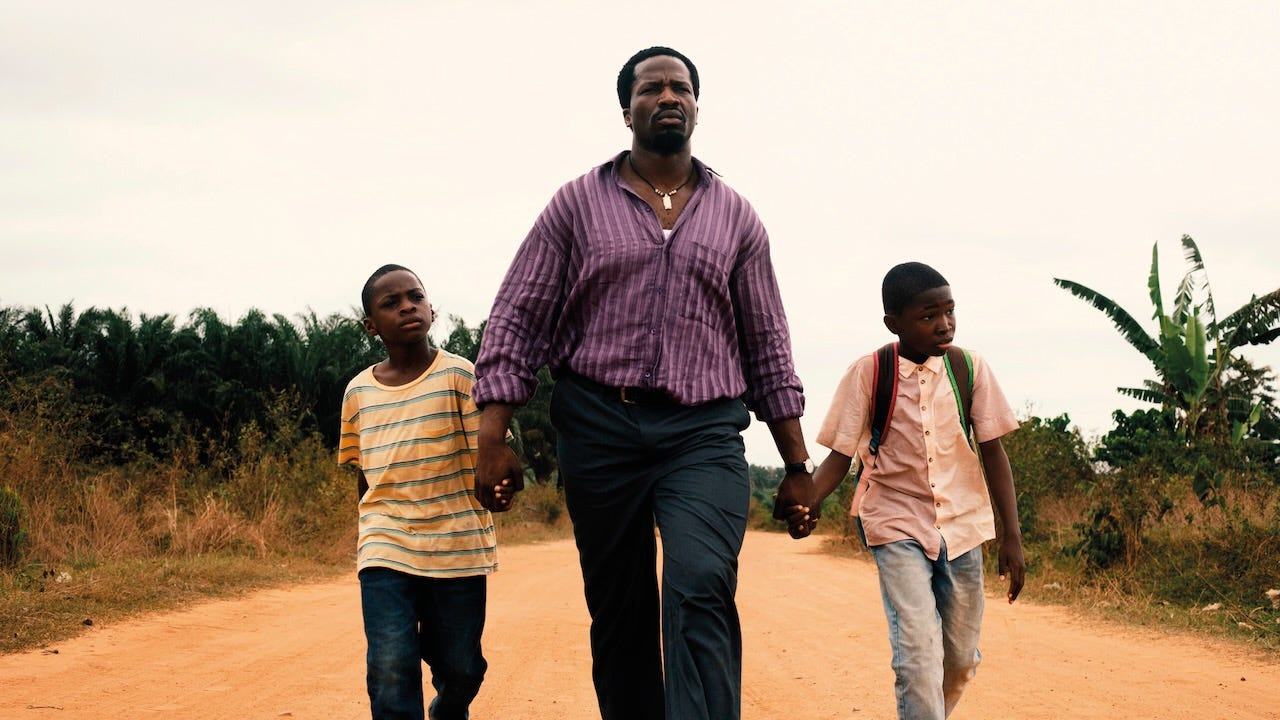
By now, you probably have read the thousands of Akinola Davies Jr.’s My Father’s Shadow reviews that have been published on Substack. That is great because this is not a review. But also because it means I am not going to be speaking into the void when I say there are only a few works of Nollywood cinema that have captured the experience of the Nigerian man quite like My Father’s Shadow.
In it, Sope Dirisu plays Folarin, a young husband and father sharply losing his grip at the peak of military rule in the ‘90s. He has gone months without receiving a salary, with no end in sight. As he decides to set off for Lagos for another try at the agency where he works for his salary, his two young sons demand to tag along. And so they set out for another episode of father and sons, trying to find meaning in life.
There have been many theories as to how Folarin died and who killed him; many theorists have pinned it on his military oppressors. But what just seems so evident to me as the obvious cause of death—suicide—has somehow been missing from the theories. This is so in large part because our society has told us over and over again, crudely and cavalierly, that the experience Folarin had in the film is normal for Nigerian men.
Yet over three decades later, Folarin’s story remains the story of many young Nigerian men, broke, depleted, and depressed with a family to feed.
After Folarin realises he had only wasted his time and would still not be paid for work he had done months ago, the father decides to head back home with his sons. The soldiers stop him, and he is further humiliated, but this time it’s different. This time he is with his sons.
The activities of Nigerian military soldiers are stark: grown men made to do frog jumps, pick pins, roll on the floor in the market.
There is almost no data on the suicide rate among Nigerians in the ‘90s. But by 2000, suicide in Nigeria stood at roughly 5.3 per 100,000 Nigerians. This means that if there were 100 million Nigerians at the time, 5,300 died in 2000 by suicide. Researchers on the subject estimate the number is way higher. By 2001, when data on suicide death rate was divided by gender, 6.9 per 100,000 Nigerian men had died by suicide.
Looking at Folarin’s life and the experiences he had had—he did all the right things his society had told him to do: marry a wife, have children, work hard, feed your family. Yet he was unable to stand tall before his family as a provider, through no fault of his own.
In an ideal world, it would have been clear that he was desperately in need of help. But a society that has told us that this kind of arduous struggle is not just part of the journey of all Nigerian men, but even what it means to be a man, Folarin falling deep into depression with no one stopping to ask him how he was doing, is exactly what we should expect.
When I was an undergraduate, the boys in my class were around 15. The total number of us in the class was roughly 55. When I did my master’s, it was less than 10. We were at least 30 in class. Data of students who enrolled at the University of Lagos in the 2023/2024 academic year suggest that fewer men are going to university.
When I decided I wanted to start a newsletter about the experiences of men, it didn’t occur to me how controversial that was—primarily because the data that men were doing poorly should ideally have been all the convincing anyone needed to know this was important work.

Not until I drafted my ambitious concept note and started sharing it with friends in the media. They gently asked me to think deeply about it and be clear about what I wanted to achieve with it. When I launched Afro Adulting Friday night, I had thought people would see the point in what I was doing and subscribe and share it. To be fair, that happened. My DMs were filled with congrats and comments from people who have been looking for a space like this. But there were also a handful of people who read the email and decided to immediately unsubscribe.
No one has had more opportunities than men in the world. There is no debate about that. The military coups that led to the jarring suicide rates among men were perpetuated by men. But toeing the side of collective punishment is a dangerously slippery slope that amplifies and abets the lack of empathy in our society, which, in the first place, ostracised every other person to the margins.
If there is anything that the reaction to My Father’s Shadow truly reinforces—how blithe we had been even to consider that Folarin committed suicide—it is how commonplace it is to look away from the depression of Nigerian men.
FOOTNOTE: This essay is part of the Afro Adulting #OfferingHelp issue. Also read other essays from the issue below:


You're very correct, and the irony of it is that they would defend the act and say of what use or worth is a man other than what he can provide, which is "money" and at the end of the day if a man only provide them with just the money or the idea thing they only think a man is made for, they seem not to be satisfied and think men are lacking in some emotional or affectionate form; it's really a rollercoaster thing for men. Women will fight against alot of things which in the real sense is normal and still want to have their way around; women are a complex being while some debates and advocacy of this era is very important I feel there's too much to hear, to much to confuse, too much to distract, too much of demand, little of supply of intentionality from people. A man's worth tied to what he can offer from a young age has things bastardized already, because he might not learn to keep other things as something valuable since he's in search of the supposed value.
This is so accurate, I also think men are beginning to be partly subconsciously aware, just that the largest part of the awareness don't seem to come from this angle, but from other angles of a "man; is only loved or valuable for what he can provide". Everyone been getting aware to the degree of what they think is so important to them and it's cool too, that's why we've a more higher statistics of wants and needs in the society in some specific human normalcy; people have turn this wants and needs to a job opportunity and are now making a living from it, an example is the matchmakers etc. Everyone seem to be talking about half or quarter of the story.