



I recently had an interaction with the famous writer and champion of the literary world, Roxane Gay, about AI use in her newsletter, The Audacity. The headline of a recent guest post, “The Space Between My Names” by a Nigerian writer, Ferdinand Ugochukwu, ironically about words, was to me at once interesting and suspect. So I dived into it.
In the third paragraph, Ugochukwu writes: “And then there is my surname, a passport I did not choose, a declaration written into the civic ledger before I drew my first breath. It hangs in the room with a kind of bureaucratic authority, and every time I hear it read aloud – whether in a ceremony, a letter, or on a page that claims I exist, it presses against the pulse of my heart. It is both mine and not mine, a label that binds me to histories I barely understand, a lineage that I carry as though it were a garment stitched too tightly, brushing my skin raw.”
The metaphors seemed to me like AI slop. Here are the portions that stood out the most: “every time I hear it read aloud…it presses against the pulse of my heart” and “a lineage that I carry as though it were a garment stitched too tightly, brushing my skin raw.” I found them silly and nonsensical in the canon of other works that have been the subject of AI use accusations that have rocked the publishing industry. That was when I decided to check and saw that the Substack AI detection feature had been disabled on the post. I ran it through Pangram, a popular AI detector whose founders have touted a 99 per cent accuracy rate. Pangram scored the post a shocking—even to me—100 per cent AI.
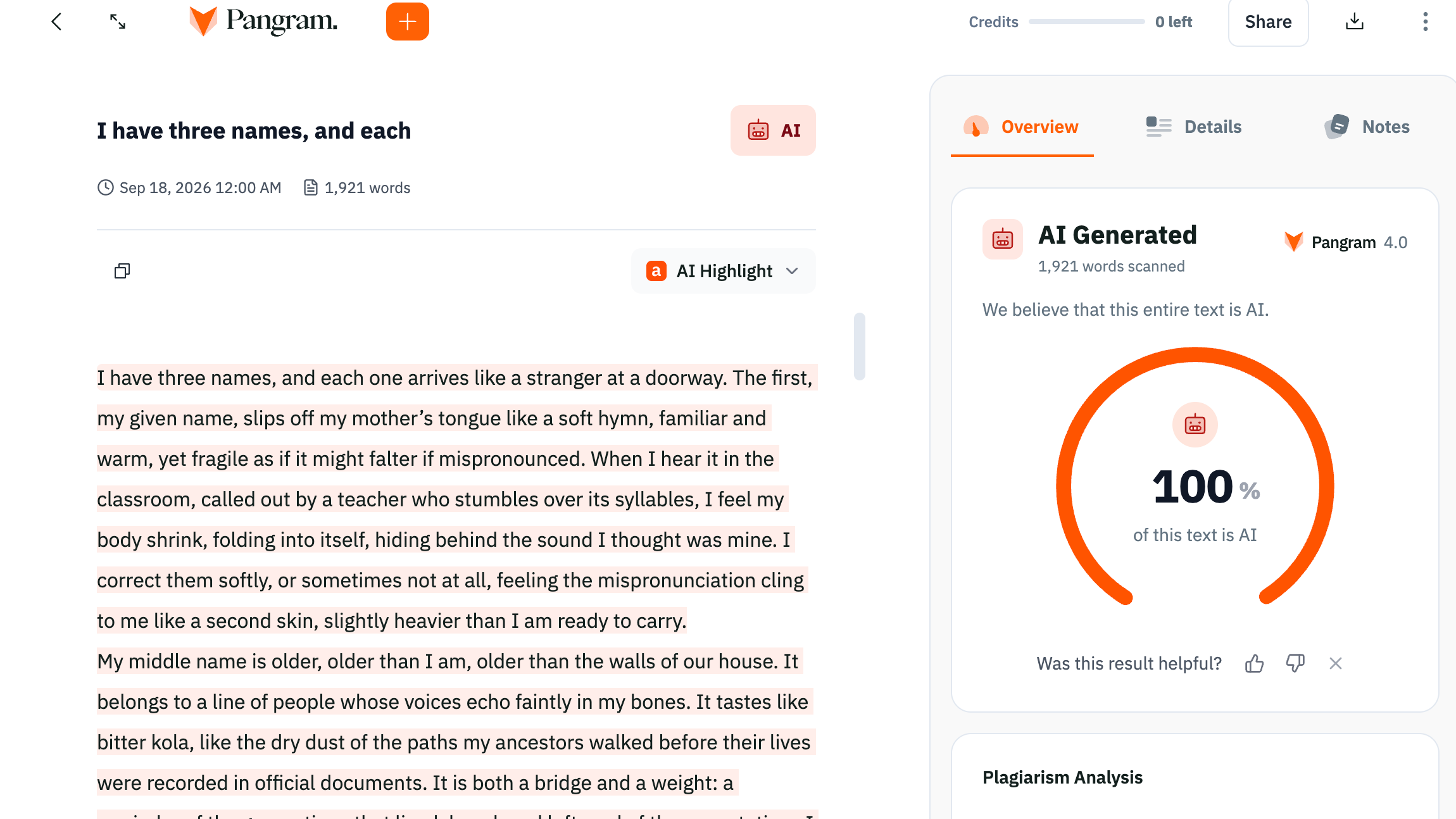
My thought was that Gay might have been tricked into publishing the piece.
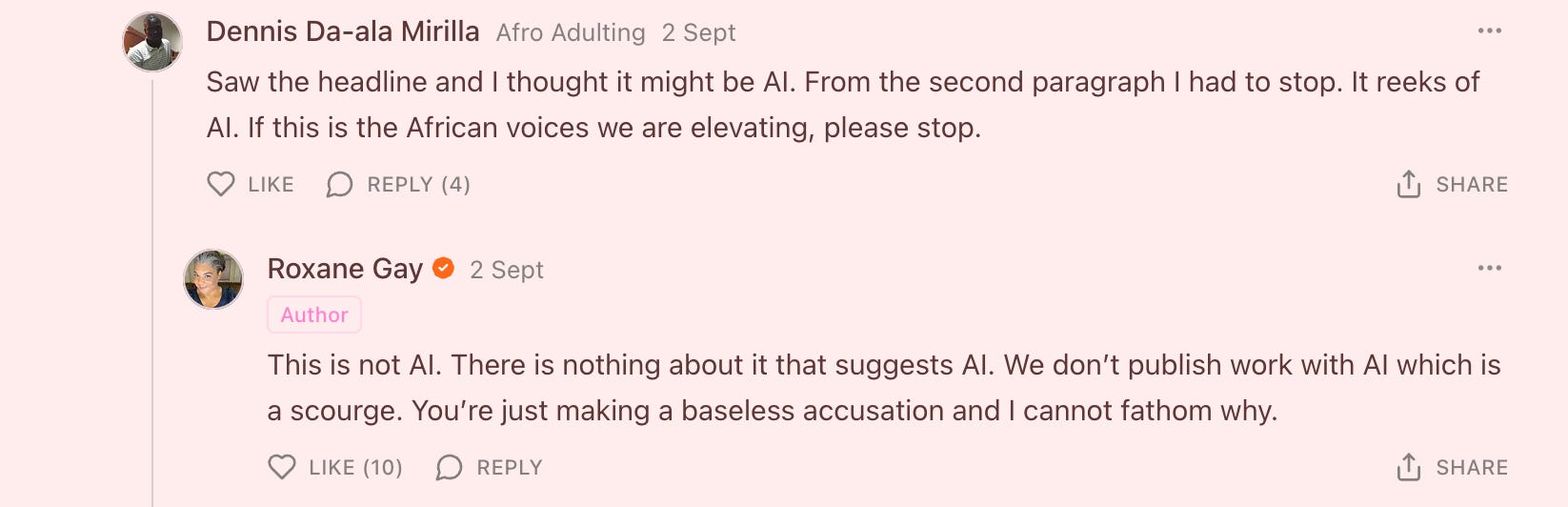
Here is the comment I dropped in the post: “Saw the headline and I thought it might be AI. From the second paragraph I had to stop. It reeks of AI. If this is the African voices we are elevating, please stop.”
Here is Gay’s response: “This is not AI. There is nothing about it that suggests AI. We don’t publish work with AI, which is a scourge. You’re just making a baseless accusation and I cannot fathom why.”
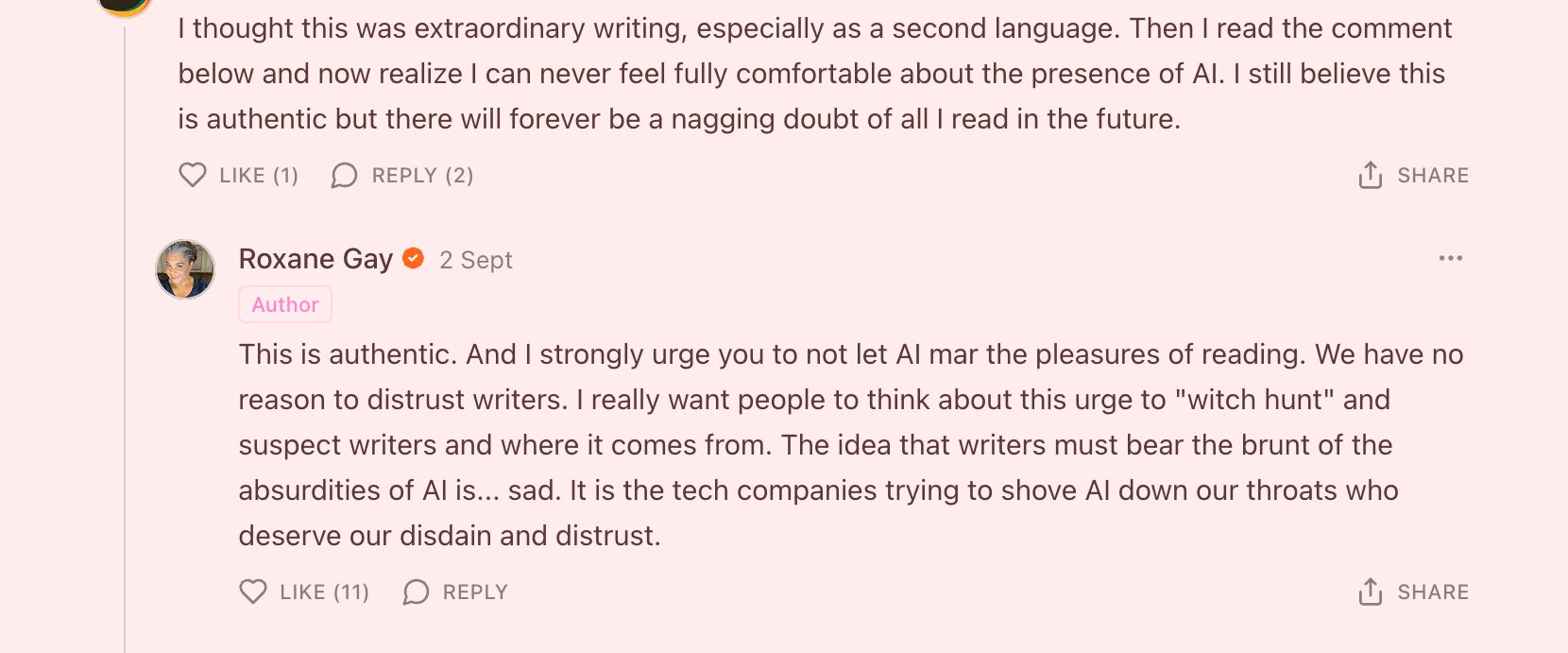
In a separate interaction with another commenter in the post, Gay said: “This is authentic. And I strongly urge you to not let AI mar the pleasures of reading. We have no reason to distrust writers. I really want people to think about this urge to ‘witch hunt’ and suspect writers and where it comes from. The idea that writers must bear the brunt of the absurdities of AI is... sad. It is the tech companies trying to shove AI down our throats who deserve our disdain and distrust.”

It might sound like a good take, a takedown even, for a fan of The Audacity on the internet unfamiliar with the inner workings of publishing. But those who know will leave their jaws on the floor in shock at the silliness of the response.
“We don’t publish work with AI, which is a scourge,” Gay said. If The Audacity doesn’t publish work with AI, then checking that the works it publishes are not written with AI should naturally be one of its standards and, as such, part of its processes. Yet, Gay said, “We have no reason to distrust writers,” almost as if the distrust and what she called a “witch hunt” emerged out of thin air.
Standards in publishing are not supposed to be outsourced to the writers — especially a writer writing for a publication for the first time — to uphold them. A standard implies that it is part of the vetting process to be published in the publication. If fact-checking is a part of the vetting process, we don’t publish works we have not fact-checked, and if a reader highlights what might be an error, we defend our actions by saying, “We have no reason to distrust writers.”
What a publisher might do to uphold their standards in this scenario is take a second look at the work and ensure they have not unintentionally dropped the ball.
There is an expression that has been thrown around by people in Gay’s camp in publishing that ultimately defends the use of AI, which directly promotes unfairness, rewards cheats, and furthers the proliferation of the scourge: witch hunt. At the height of the controversy over the Commonwealth Short Story Prize regional winners who were accused of writing their work with AI, “witch hunt” was the expression used to discard the allegations that the winning work in particular was at least written partially with AI. The writer, Jamir Nazir, has since claimed in an interview that he used a speech-to-text tool to produce the work due to ill health. He has rejected all the AI allegations and said in an interview with Big Think that “There’s no way these [AI detection] tools are admissible in a court of law.”
At least one of the writers who vociferously defended him went on to publish a short story that scored equally high on Pangram.

Many writers also in this camp will occasionally claim to have fed Pangram human-written works by famous writers or by themselves that scored high on Pangram, but fall short of sharing the work with the public to come to their own conclusions.
I can regurgitate reasons why we should not publish or take seriously people who go to chatbots, give them silly prompts, and then publish the garbage online as their original work or claim to have made only a few alterations to the work. Grammarly has become part of how many writers do their work; it makes suggestions, and sometimes writers take those suggestions. Yet the works do not come out reading like AI slop or scoring high on Pangram. Rather, I will focus on an evil that we should be mindful of as the publishing world seeks to gain new readers in the age of AI, lest we fail.
We are living in the golden age of the ideologues. From the left to the right to the centre, ideologues and their idealism have hijacked common-sense thinking. Our focus increasingly seems to be about defending our camps rather than seeking the truth as naive but curious children that we all are. From this standpoint, staunch opponents of AI use in the literary world can become some of the most ardent defenders of the practice.
Of course, it is not only in The Audacity that I encountered work that I thought might have been written by AI. But it is the first place where I thought the publisher was fully on the side of human-written work and might have been tricked. If we truly want to reject the AI scourge, then we must make a deliberate attempt to reject it. There is no other way.
