


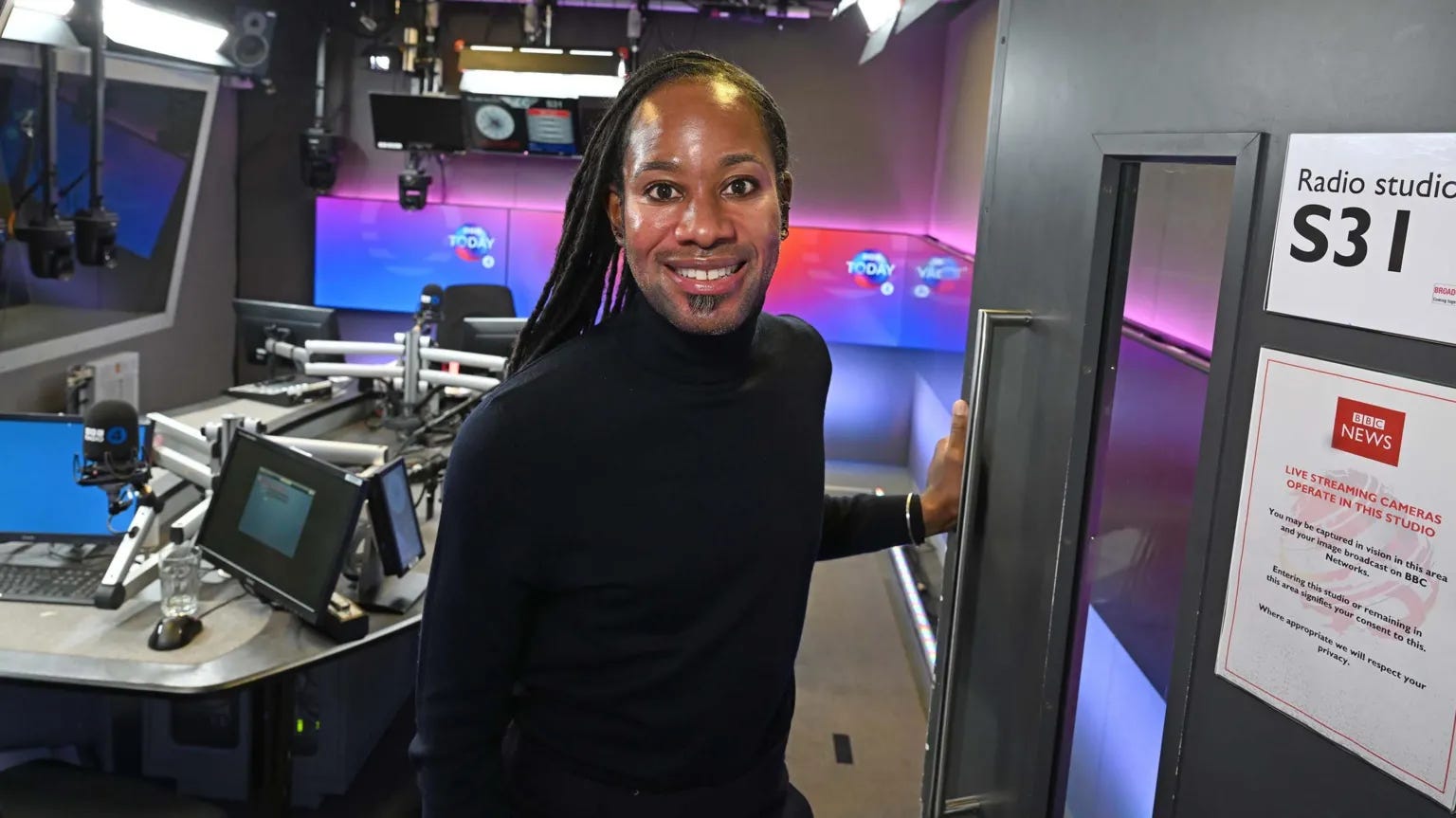
Jason Arday is a British Ghanaian professor at the University of Cambridge. When he joined Cambridge in 2023, he was just 38, making him the youngest Black professor in the university’s history. But now, among other things, the validity of a book he claimed he authored is being questioned.
Arday had implied on multiple occasions that Being Young, Black and Male: Challenging the Dominant Discourse, a book about Black masculinity, was published by Palgrave Macmillan.
In Cool Britannia and Multi-Ethnic Britain: Uncorking the Champagne Supernova, his 2019 book, Young, Black and Male, was listed among the other works by the author. At an event the same year at Queen’s University Belfast, promotional material attributed him as the author of the said book. A 2020 essay he wrote also made a similar claim. When he worked at Durham University in 2020, the book was also cited on his page as a “manuscript in preparation.” An interview he did in 2022 with the podcast, Now and Men, was titled “Prof Jason Arday - Being Young, Black and Male: Challenging the Dominant Discourse.”
Now, Palgrave Macmillan says that although it received the manuscript of the book years ago, it has since been canned. It was never published. How then did he get hired at Cambridge, as applicants for professorships are expected to submit their complete bibliography?
Arday has faced even more allegations, including plagiarising his PhD thesis, which he says was as a result of his autism, claiming to have been a visiting professor at the University of Glasgow, Ohio State University, Nelson Mandela University, among others, all of which now say he never worked there in that capacity. His claim to have run 600 miles in six days has also come under scrutiny. He claimed in an interview to have been featured in the British documentary Seven Up!, which was released on May 5, 1964, before Arday was born.

Arday has denied these allegations, claiming they are racially motivated. “There is a well-documented playbook for discrediting Black academics in high-profile positions, and it’s been used to devastating effect in the U.S. and now with me in the U.K.,” he told The New York Times in a statement. “My greatest hope is that what is happening to me now will serve to further expose these actors and forces.”
Next week, 37 Ink, an imprint of the publisher Simon & Schuster, is expected to release his memoir Great and Unfortunate Things. By all accounts, the publishers seem to be going ahead with the plan. “We have worked closely with Professor Jason Arday on Great and Unfortunate Things since acquiring it and can speak to the professionalism and integrity he has brought to every stage of the publication,” they said in a statement to the Times. “He worked closely with his co-writer (Eve Claxton), as well as our editorial and legal teams, to carefully research, write and corroborate the narrative.”
If you ever felt like your work was rejected because it didn’t push a specific narrative of the downtrodden person of colour, this is even more evidence you are not crazy, and the publishing industry is specifically doing this and doing it rather shabbily. Great works need only to be honest and well told. But Arday gets a co-writer, presumably to do the heavy lifting of actually writing the book, when many talented writers who are Black can’t even get a job. In my view, this is why people are turning away from buying and reading books.
Think about it. What did Cambridge read that excited its panel so much that they made Arday a professor if some of the work was heavily plagiarised and likely not fresh thinking, and one of the books didn’t even exist? What then is to say of hard work that is supposed to propel us to success if this is what the system chooses to favour?
But there is even more trouble afoot here. The accusations of plagiarism in Arday’s PhD thesis were first brought to the public’s attention by Nathan Cofnas, who has said, “In a meritocracy, Harvard faculty would be recruited from the best of the best students, which means the number of Black professors would approach 0%. Blacks would disappear from almost all high-profile positions outside of sports and entertainment.”
It is always tough to face public scrutiny as a member of an already marginalised group. But this is no reason for us to reject such scrutiny, even when it makes us uncomfortable, even when people like Cofnas call for it. In fact, this scrutiny can be good for us because it ultimately reveals bad-faith accusations that permeate the internet these days, but also evidence of fraudulence should a fraud emerge.
It has no doubt been a couple of seemingly terrible weeks to be a Black public thinker. But the actions of these people are worse than the racists because they offer credence to the racism; they legitimise it by offering themselves as proof.
Cambridge University was not particularly thrilled by Arday’s performance, as they now say they have launched an investigation into some of the allegations. But they let him into their faculty most likely because of optics, even if he probably wasn’t moving human enquiry forward. Black people who have earned the right should be given professorships, but they should not agree to professorships that will help institutions like Cambridge tick their DEI boxes, especially if they will not even subject us to the rigour of reading our work and defending it before their panel.
Those who seek to pull us down and do us harm have increasingly been emboldened as part of the “centrist” anti-DEI movement in the West. If people like Arday are supposed to be the public intellectuals who will defend our credibility, then we have something even worse coming.
Too many times we allow ourselves to be swayed by the résumé and not the ideas, which are supposed to be the metric for how judiciously one might use an opportunity. We must not defend these people.
In a sense, we are also all at fault here. Why should it be Cambridge that decides who the bright thinkers are in the age of TikTok? Why is it only after someone has attained the approval of the establishment that we then realise that they are stars? We may have outsourced our taste to the establishment to determine for us what is good and then take whatever it is they offer. Then, in times like this, we wonder if we should stand with our own that was accepted even if they might not have crossed the bar to begin with.
If we care even remotely about who represents us, the people speaking about the Black experience, the myths, biases, and lies about Black people, then we need to root out the frauds within our ranks. This is a hill I am willing to die on.
